Project Overview
Wharton@Work is the flagship newsletter and digital communications journal for Wharton Executive Education. I have owned the design, development, and infrastructure of this publication since its launch in 2001 — from building the original article archive system to leading two major redesign initiatives more than a decade apart.
The archive I architected enables users to discover content by monthly issue, topic category, and faculty author, and has become a meaningful driver of organic search traffic to the Wharton Executive Education website.

The Challenge
By 2019, both the newsletter email and the communications journal website were showing their age. The 2014 designs had served well, but evolving user expectations, mobile usage patterns, and content publishing needs made a refresh overdue. The core problems were:
- Email engagement was low. The clicked-to-opened ratio sat at just 1.37%, signaling a disconnect between content and presentation.
- The website was difficult to navigate. Users had trouble finding relevant articles, and the rigid issue-based structure made timely publishing difficult.
- The design felt dated. Both the email and the web experience lacked the visual clarity and flexibility expected of a leading business institution.
Research & Discovery
Before making any design decisions, I grounded the redesign in evidence:
- Website analytics revealed how users were actually navigating the archive — where they landed, where they dropped off, and which navigation paths went unused.
- Competitive analysis examined how peer institutions and leading business publications presented editorial content online.
- Usability and SEO best practices informed decisions around content structure, heading hierarchy, and discoverability.
These inputs shaped a clear design direction: move away from the rigid monthly-issue model toward a modern, continuous editorial format — one that would let the team publish articles as soon as they were ready rather than batching them by issue.
Email Redesign (Launched 2020)
The email redesign focused on two goals: simplifying the visual experience and making the template technically robust across devices.
Design decisions:
- Streamlined the layout by consolidating redundant content sections
- Reduced visual noise to draw attention to article headlines and CTAs
- Shifted from a desktop-first to a mobile-first design philosophy
Development approach:
I coded the new template using Marketo’s modular responsive email framework, taking advantage of its drag-and-drop content blocks to give the editorial team greater flexibility without requiring code changes for each issue.
Results:
| Metric | Before (2014) | After (2020) |
|---|---|---|
| Clicked-to-Opened Rate | 1.37% | 12.54% |
| Unsubscribe Rate | — | 0.167% |
The clicked-to-opened rate increase of over 9x reflects a dramatically more engaging email experience — readers who opened the newsletter were now far more likely to click through to read articles.
-

- Mobile 2014 newsletter
-

- Desktop 2014 newsletter
-

- Desktop 2020 newsletter
-

- Mobile 2020 newsletter
Website Redesign (Proposed 2022)
The website redesign addressed the structural and navigational limitations of the 2014 communications journal. My proposed direction introduced a modern blog-style layout with the following improvements:
- Architecture shift: Moving from an issue-based archive to a continuous publishing model, allowing articles to be posted immediately upon completion. This would enable the team to respond to trending business topics in near-real time.
- Navigation improvements: Cleaner categorization and filtering to help users find relevant content faster, with better SEO structure to sustain and grow organic traffic.
- Visual modernization: Updated typography, spacing, and layout to align with contemporary editorial design standards and the broader Wharton brand.
Wireframes were developed for both the main landing page and individual article pages, with prototypes reviewed against analytics data to validate navigation assumptions before moving to development.
-

- Proposed Main Page Wireframe
-
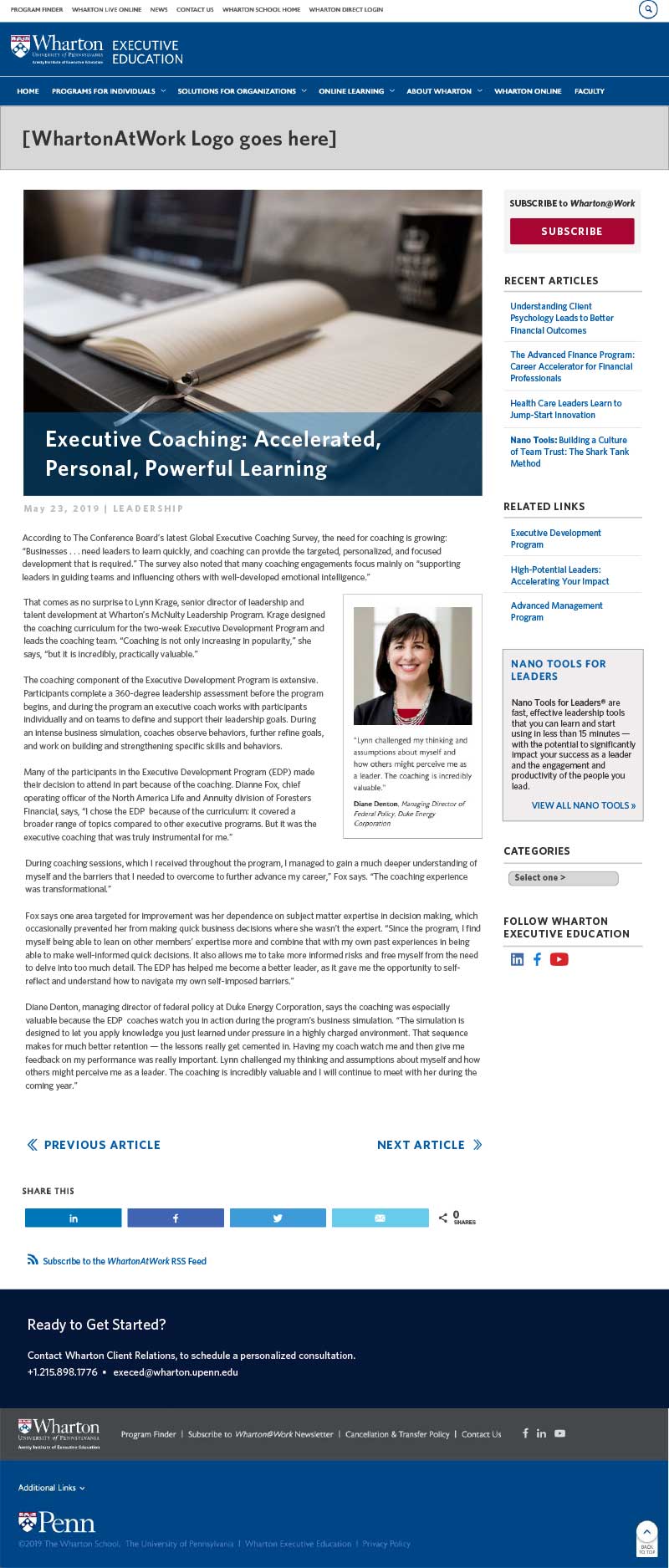
- Proposed Article Wireframe
Key Takeaways
This project spans over two decades of iterative design work on a single publication — an unusual opportunity to watch a product evolve alongside its audience and the broader digital landscape. The 2020 email redesign demonstrated that even incremental changes to layout and structure, when grounded in user behavior data, can produce outsized results. The proposed 2022 website redesign carries that same philosophy forward: less structural rigidity, more responsiveness to how and when readers want to engage with content.